![My prostate chip won't go in—or feels too big and painful | Smaller dimensions do not guarantee a comfortable fit [OK Prostate Chip]](/img/a/T0342/eyecatch.svg)
This page is based on entries from "ok-lab's diary" (https://ok-lab.hatenablog.com/), the Japanese development diary written by Mr. Okada, founder of OK Lab, a small company in Japan (Okada Comfortable Life Laboratory). Only the entries about "a chip that won't go in or feels too big and painful" are summarized here, in order of publication. Past prices and sizes are as written at the time. Current prices come from the official product list (retrieved September 4, 2026). Quotations are translated from Japanese.
Note: This page is a personal reading log by someone with no connection to the maker or the seller. It reflects the source entries as of their publication dates and makes no guarantee of accuracy or safety. The product is not a medical device; talk to a doctor about any health decision. Check the official site for current information. This page contains advertising.
In short
A chip can be too big at its rear attachment, even when the front fits.
The maker offered smaller builds and workshop adjustments, and later advised stopping use when pain recurs.
Current products remain listed, but the diary gives no size that fits everyone.
About this product

The OK Prostate Chip is made by OK Lab (Okada Comfortable Life Laboratory), a small company in Japan. The product is made in Japan, sold from Japan through the company's own online store, and priced in Japanese yen. The maker's development diary, "ok-lab's diary", is written in Japanese; this page is an English summary of it, and every quotation is translated. OK Lab ships internationally, so readers outside Japan can order (see "Buying from outside Japan" below). Product names on this page are plain-English descriptions; the official Japanese store name is shown once in the product table so you can find the same item in the store.
Before you read: key terms
| Term | Plain-English meaning |
|---|---|
| Urethra | The urine passage, where the diary describes placing the chip to act on the prostate. |
| Sphincter | A closing muscle around the urine passage; the maker describes it as a point of support for the chip. |
| Resin | Material used for chip bodies and coatings, including attachments for threads and motors. |
| Motor | A component that produces vibration; its dimensions do not include the surrounding protective coating. |
| Electrode | An electrical contact used to deliver stimulation. |
| Wire-loop device | A flexible loop assembly used for stimulation instead of a solid chip. |
What happens: prostate chip fit problems
The OK Prostate Chip is a small device placed in the urethra (urine passage), intended by its maker to press on the prostate. Reported fit problems involve its length, width, thickness, or attached parts, including the rear section where a retrieval thread connects. In the diary, difficulty occurs both at the opening and near the sphincter (a muscle that closes around the urine passage).
A chip won't go in merely because its front end fits
In an entry published in February 2018, a customer reported that the 7 mm front section fitted, but the 9 mm rear section would not pass. Mr. Okada asked for the customer's preferred dimensions and made a replacement. He acknowledged that increasing the standard size in response to earlier feedback had overlooked individual differences.
The diary does not record the outcome. Mr. Okada invited customers with similar fit problems to contact him about replacements made to their requested dimensions.
(Source: ok-lab's diary, published February 2018)
https://ok-lab.hatenablog.com/entry/20180221/1519195742
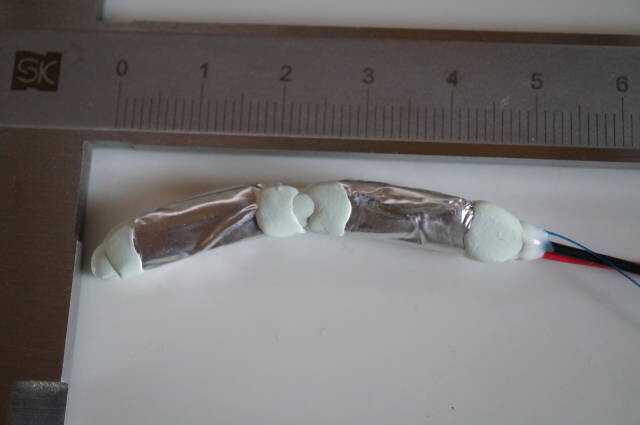
A vibrating chip became too big after resin covered its motor
In an entry published in April 2019, a customer requesting three motors asked whether the proposed dimensions would fit. OK Lab explained that resin (a material used for protective coatings) increased the finished dimensions around each motor (the vibration-producing component). The maker reported that around 15% of buyers of a long model with a 10 mm motor had reported insertion failure.
He acknowledged that buyers who had not replied might also have experienced difficulty. An aluminium-covered custom build was completed, but the diary does not record that customer's fitting result. OK Lab suggested a two-motor alternative if the proposed three-motor dimensions seemed too large.
(Source: ok-lab's diary, published April 2019)
https://ok-lab.hatenablog.com/entry/2019/04/06/151323
A thinner motor assembly still meant the chip wouldn't fit
In an entry published in August 2019, a customer said an 8 mm motor assembly was acceptable in width but too thick. Mr. Okada explained that the motor and protective coating produced a thickness of about 6 mm. He accepted it for workshop adjustment, which reduced the thickness to 5 mm, while declining to guarantee its subsequent durability.
A follow-up published later in August 2019 confirmed that the adjusted chip still would not fit through the opening. Mr. Okada could not judge whether the plain vibrating chip would meet the customer's intended purpose. However, he suggested it as a fitting alternative because of its shorter, rounded shape.
(Source: ok-lab's diary, published August 2019)
https://ok-lab.hatenablog.com/entry/2019/08/10/125102
(Source: ok-lab's diary, published August 2019)
https://ok-lab.hatenablog.com/entry/2019/08/24/125858
A short ceramic chip wouldn't fit despite success with resin
In an entry published in May 2020, a customer requested a more pronounced waist after a short ceramic chip would not fit. The customer's single-chip resin model had fitted without the same difficulty. OK Lab declined the requested ceramic shape, explaining that its narrow section needed sufficient thickness for strength.
The workshop instead offered thread replacement with a smaller rear attachment for ¥1,100 (about $7 at ¥156 = $1, rate as of 2026-09-04), as published in May 2020. The diary does not record the outcome. OK Lab cautioned that the proposed thinner attachment could be weaker.
(Source: ok-lab's diary, published May 2020)
https://ok-lab.hatenablog.com/entry/2020/05/02/131505
Workshop resizing resolved one case where a steel chip wouldn't fit
A follow-up published in November 2023 confirmed that a custom steel twin chip fitted after workshop adjustment. The preceding October 2023 entry recorded a thickness of 9.6 mm, with width exceeding 10 mm at some measuring angles. The customer had expected it to fit because a different 10 mm instrument did.
The follow-up also praised the rounded front, while suggesting further improvement at the rear. No matching product can be confirmed on the current list. For this fitting complaint, Mr. Okada had offered adjustment at the workshop.
(Source: ok-lab's diary, published October 2023)
https://ok-lab.hatenablog.com/entry/2023/10/21/123054
(Source: ok-lab's diary, published November 2023)
https://ok-lab.hatenablog.com/entry/2023/11/04/122744
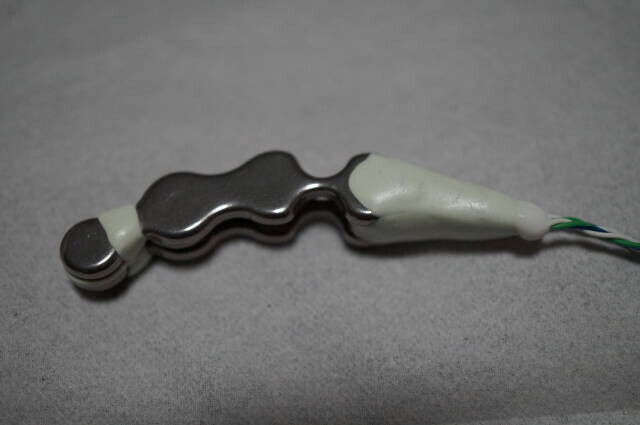
Even flexible loops proved too big during one custom build's trials
In an entry published in April 2025, a customer initially could not accommodate a custom assembly with 0.4 mm double wires and double loops. This wire-loop device (a flexible assembly replacing a solid chip) had the strongest spring action offered, according to staff. They also acknowledged that Mr. Okada had not personally tested that exact configuration.
Later messages in the same entry confirmed successful fitting, although the customer found the stimulation too strong for prolonged use. No matching product can be confirmed on the current list. Mr. Okada advised choosing a more modest initial configuration after finding powerful versions excessive in his own tests.
(Source: ok-lab's diary, published April 2025)
https://ok-lab.hatenablog.com/entry/2025/04/12/122910
The maker's answer to prostate chip fit problems
The maker describes downsizing and workshop changes, but his latest reply advises stopping when use repeatedly causes lasting pain.
The maker listed downsizing when a chip won't go in
In an entry published in July 2021, Mr. Okada included an oversized chip among possible explanations for failure at the opening. His draft instructions listed choosing a smaller chip as a response. The document also addressed unusual discomfort separately from simple difficulty fitting the device.
It warned against customer repairs or alterations. Mr. Okada advised stopping use when discomfort differed from normal.
(Source: ok-lab's diary, published July 2021)
https://ok-lab.hatenablog.com/entry/2021/07/24/125923
Slimmer connections addressed assemblies that became too big at their rear
In an entry published in June 2022, a customer reported that several cable-connected chips failed at the opening because their rear attachments were too thick. Mr. Okada acknowledged that earlier connections added about 2 mm compared with thread-connected chips. He also noted that this customer's request for a fuller rear shape had influenced the builds.
The entry says four-wire support was no longer available and describes a revised connection that produced a slimmer rear section. The diary does not record the outcome. Mr. Okada offered the prospect of thinner assemblies using the revised connection design.
(Source: ok-lab's diary, published June 2022)
https://ok-lab.hatenablog.com/entry/2022/06/11/123420
Custom rebuilding offered alternatives when an electrode chip looked too big
In an entry published in October 2024, OK Lab noticed a mismatch between requested dimensions and a customer's stated size limit. The customer's existing resin chip was 3 mm thick, while the proposed electrode chip, containing electrical contacts for stimulation, was substantially thicker. Staff offered rebuilding or cancellation after acknowledging that they had overlooked the customer's limitation.
Further discussion established an intended thickness of 5.5–6 mm, and the customer requested a remake 50 mm long and 7 mm wide. A remake was completed, but the diary does not record the outcome. OK Lab advised considering cancellation because narrower dimensions still could not guarantee fit.
(Source: ok-lab's diary, published October 2024)
https://ok-lab.hatenablog.com/entry/2024/10/19/122847
Painful chip use drew advice to stop when symptoms kept returning
In an entry published in July 2026, a customer asked whether painful urination lasting 2–3 days after first use would disappear with experience. Mr. Okada considered injury, existing inflammation, unsuitable size, and other possibilities; he did not establish a cause. He distinguished an isolated past episode from pain lasting several days after repeated uses.
The diary does not record the outcome. Mr. Okada advised stopping while pain remained, discontinuing use if prolonged pain recurred, and seeking a urologist's assessment where appropriate.
(Source: ok-lab's diary, published July 2026)
https://ok-lab.hatenablog.com/entry/2026/07/25/123012
If you see blood in your urine, even a small amount or for the first time, do not wait and see. See a urologist right away.
If you suddenly cannot urinate, or the device cannot be removed, do not try to fix it yourself. Go to a medical facility, including emergency care, immediately.
How prostate chip fit problems changed over time

| Published | What the diary said then |
|---|---|
| Feb 2018 | Standard dimensions had increased from about 6–8 mm to 7–9 mm; fit complaints prompted replacements. |
| Apr 2018 | A painful straight 4 cm chip prompted development of a curved intermediate-length prototype. |
| Aug 2020 | Sharp thread-attachment complaints prompted rubber covers for specified designs. |
| Jul 2021 | Draft instructions listed downsizing and warned against home alterations. |
| Jun 2022 | Revised cable connections reduced rear bulk; four-wire support was no longer available. |
| Jul 2022 | A 4 mm tube option followed pain complaints about the 6 mm version. |
| Aug 2022 | Tube discomfort prompted a pause in new tube proposals; existing-order manufacturing continued. |
| Feb 2025 | Earlier stainless-wire-reinforced cable designs had all been discontinued following breakage reports. |
| Jul 2026 | Repeated days of urinary pain prompted advice to discontinue use. |
OK Prostate Chip products related to prostate chip fit problems

The current list includes products discussed in these reports, but the diary provides no universal fit recommendation.
Products that appear in these entries
| Product (official name) | Price incl. tax | Relation to this topic |
|---|---|---|
| Short ceramic chip (OKプロステートチップ 陶器素材ショートタイプ) | ¥3,300 (about $21 at ¥156 = $1, rate as of 2026-09-04) | In May 2020, a customer reported that this model would not fit and asked about a different waist shape. |
| Single-chip resin model (OKプロステートチップ 樹脂素材1チップタイプ) | ¥2,200 (about $14 at ¥156 = $1, rate as of 2026-09-04) | In May 2020, the same customer reported successful fitting with this model before difficulty with the short ceramic chip. |
Products the diary recommended
| Product (official name) | Price incl. tax | Relation to this topic |
|---|---|---|
| Plain vibrating chip (OKプロステート核振チップ プレーン(胎児チップ)) | ¥3,300 (about $21 at ¥156 = $1, rate as of 2026-09-04) | In August 2019, Mr. Okada suggested this shorter shape after a customer's larger vibrating assembly still failed following adjustment. |
These listed prices do not establish availability of the historical custom dimensions. For the custom three-motor build: No matching product can be confirmed on the current list.
The June 2022 entry says four-wire support was no longer available. In February 2025, Mr. Okada reported that earlier stainless-wire-reinforced cable designs had all been discontinued after breakage reports.
Common worries about prostate chip fit problems

The diary does not establish fit from another object's diameter, spare thread length, or a beginner label.
"Does spare thread explain why my chip won't go in?"
In an entry published in December 2020, a beginner described four unsuccessful attempts with a twisted chip and asked about 15 cm of remaining thread. Mr. Okada said individual differences prevented him from identifying the chip's position from that measurement. He also acknowledged that he could not explain the customer's prickling sensation from his own experience.
The diary does not record the outcome. Mr. Okada suggested that a simpler, untwisted shape would present less resistance than the twisted front chip.
(Source: ok-lab's diary, published December 2020)
https://ok-lab.hatenablog.com/entry/2020/12/12/124126
"Can the smallest chip still be too big for beginners?"
In an entry published in September 2021, a prospective buyer asked whether a short glass chip was the best starting choice. Mr. Okada declined to identify one material or model as best for beginners. He said preferences differed and reported complaints that even the smallest chip would not fit.
The diary does not record the outcome. Mr. Okada offered no universal beginner recommendation because suitable sizes and preferred materials varied between individuals.
(Source: ok-lab's diary, published September 2021)
https://ok-lab.hatenablog.com/entry/2021/09/11/125735
"Could a chip that's too big require hospital removal?"
In an entry published in May 2024, a customer sought help after the thread broke on another seller's stainless-steel chip. Staff initially expected spontaneous passage might occur, but the customer later reported hospital removal. The customer described the chip as too large for them, giving dimensions of 10 mm wide and 30 mm long.
A follow-up published in June 2024 confirmed a hospital stay of 2 nights and 3 days. No matching product can be confirmed on the current list. Mr. Okada offered help identifying an experienced doctor if removal elsewhere proved difficult.
(Source: ok-lab's diary, published May 2024)
https://ok-lab.hatenablog.com/entry/2024/05/25/122919
(Source: ok-lab's diary, published June 2024)
https://ok-lab.hatenablog.com/entry/2024/06/01/123036
Buying from outside Japan

OK Lab ships internationally to countries covered by Japan Post's EMS service. Overseas orders are paid in advance by PayPal. Each order carries a ¥400 (about $3 at ¥156 = $1, rate as of 2026-09-04) handling fee, and EMS shipping is charged on top. Check the official store for the current terms before you order.
Summary of this article
| What you wanted to know | The answer |
|---|---|
| What is the main finding? | A smaller front section does not establish that the entire chip will fit. |
| Who makes the product? | OK Lab, a small company in Japan, makes and sells it from Japan. |
| Which terms matter? | Finished dimensions include chip material, motor coatings, and attachments. |
| What happened in the reports? | Workshop resizing helped some customers; a thinner motor assembly still failed for another. |
| What did the maker suggest? | Downsizing, workshop assessment, and stopping when use repeatedly caused lasting pain. |
| What changed over time? | Attachments became slimmer, tube options changed, and some cable designs were discontinued. |
| What do related current products cost? | The listed resin model costs ¥2,200 (about $14 at ¥156 = $1, rate as of 2026-09-04); the ceramic and plain vibrating models each cost ¥3,300, (about $21 at ¥156 = $1, rate as of 2026-09-04) including tax. |
| Can another measurement establish fit? | The diary does not establish fit from spare thread length or another object's diameter. |
| How do overseas orders work? | Advance PayPal payment, a ¥400 (about $3 at ¥156 = $1, rate as of 2026-09-04) handling fee, and additional EMS shipping apply. |
Source: ok-lab's diary (Okada Comfortable Life Laboratory). The original entries are in Japanese; quotations on this page are translated. Photos and videos are on the original entries.
This article is a summary of the maker's development diary. The product is not a medical device and no result is guaranteed. If anything feels wrong or worries you, see a doctor. Prices, specifications and cautions change, so confirm the latest information on the official blog and the official site. Questions about ordering and shipping go to the seller.